30th Celebration Best Cards to Invest In: Crystal Lugia, Charizard & Top Chase Cards
Two weeks before the Pokémon TCG 30th Celebration launch, here are the cards that will define its secondary market — ranked by upside and risk. Futuristic Rare Mewtwo ex, the Base Set Charizard reprint, Crystal Lugia, the 30-card Pikachu chase, and the sleepers nobody is pricing yet.
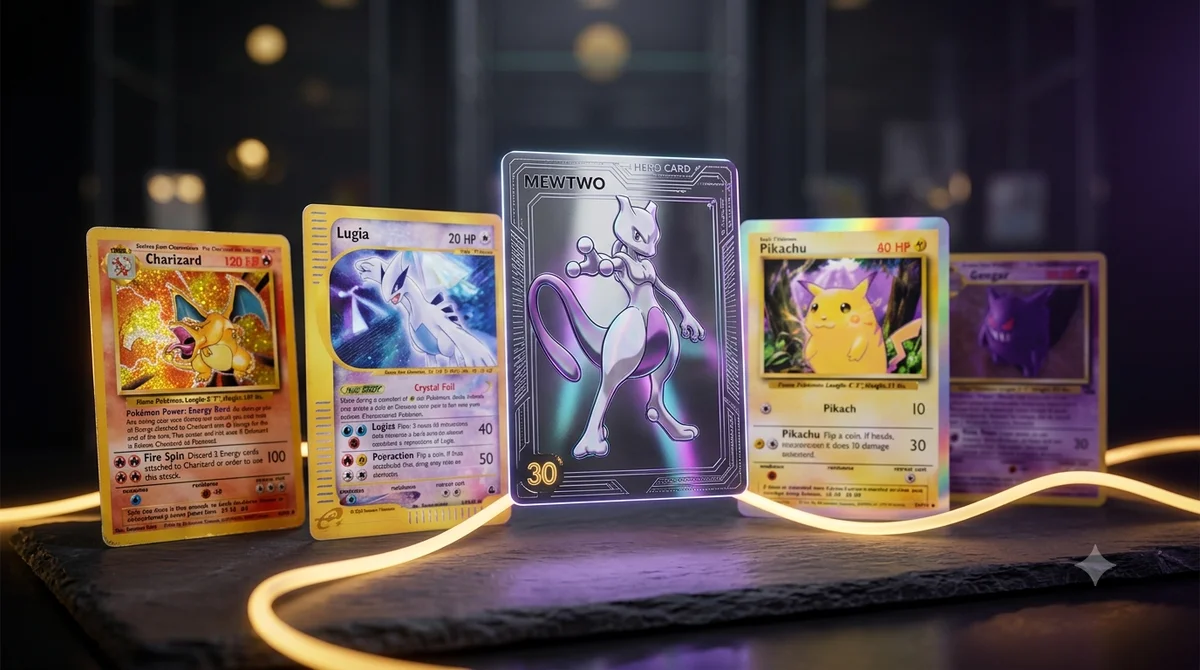
30th Celebration Best Cards to Invest In: Crystal Lugia, Charizard & Top Chase Cards
🟠 T-MINUS 14 DAYS (September 2, 2026): The Pokémon TCG 30th Celebration set launches worldwide on September 16, 2026. Every card in the set is foil, every pack contains a Pikachu, and the brand-new Futuristic Rare has no price history at all. This is the last clear-headed window to decide what you actually want before launch-week pricing makes the decision for you.
Quick Answer: The best 30th Celebration cards to invest in fall into three tiers. Tier 1 is the new Futuristic Rare Mewtwo ex and Mew ex — highest ceiling, highest risk, no price anchor. Tier 2 is the Classic Collection blue chips: the Base Set Charizard reprint and "Crystal" Lugia (Aquapolis), two cards whose originals are permanently out of reach for most collectors, now available in a stamped anniversary form. Tier 3 is the sleepers — Gengar Prime, the two-card Darkrai & Cresselia LEGEND, Shining Celebi and the Magikarp Illustration Rare — cards with dedicated followings that pre-launch hype is under-pricing. The single most reliable play across all three tiers is patience: buy the week 3–4 cooldown, not the launch-week spike.
Anniversary sets don't behave like normal releases. They are printed for a limited window, they are bought by people who don't otherwise buy modern Pokémon, and their best cards are usually the ones that connect to something a collector already loves. Celebrations (2021) proved it — the Classic Collection reprints carried that set, not its new cards.
The 30th Celebration set is the same idea at a larger scale: around 150 cards, all foil, 30 Classic Collection reprints spanning 1996 to 2023, a guaranteed Pikachu in every pack, and one entirely new rarity. That's four separate demand engines running at once — and they will not all appreciate equally.
This guide ranks what's actually worth your money. Not "everything is a good investment because it's the anniversary set" — a real tier list, with the risk on each pick stated plainly.
Key Takeaways
- 🥇 Highest ceiling: Futuristic Rare Mewtwo ex — marquee Pokémon, brand-new rarity, named guest artist, zero supply precedent.
- 🏆 Safest hold: The Base Set Charizard Classic Collection reprint. The most valuable name in the hobby, in the most accessible form it has ever taken.
- 💎 Best risk-adjusted pick: "Crystal" Lugia (Aquapolis) — a Wizards-era grail whose Crystal-type mechanic never returned, and whose original is priced out of reach for almost everyone.
- 🕵️ Sleepers: Gengar Prime, Darkrai & Cresselia LEGEND (both halves), Shining Celebi, and the Magikarp Illustration Rare.
- ⚡ The Pikachu engine: 30 numbered Pikachu illustrations (1/30–30/30) create sustained completionist demand — but individually most will stay cheap.
- 🚫 What to avoid: Launch-week singles at any price, sealed "mystery" anniversary bundles, and the assumption that a stamp alone makes a reprint valuable.
- 📅 The plan: Decide your list now, buy sealed at MSRP if you can, and set alerts for the week 3–4 single-card cooldown.
⚡ Quick Navigation
How to Rank a Chase Card Before Launch
📌 TL;DR: Five factors decide which anniversary cards hold value: character equity, mechanical uniqueness, the price of the original, scarcity of the reprint, and whether the card is someone's favourite. Cards scoring high on three or more are the ones worth buying.
Before the tier list, the method. Anniversary reprints are a strange asset: the card is new, but the demand is old. Here is what actually separates the reprints that appreciate from the ones that sit in bulk bins:
- Character equity. Charizard, Pikachu, Mewtwo, Lugia and Gengar carry demand that exists independently of the TCG. Delcatty does not. This is the single biggest factor and it barely moves over decades.
- Mechanical uniqueness. Crystal-type, Shining, Prime, LEGEND and δ (delta species) are one-era mechanics that never came back. Cards representing a mechanic that died are collected as artefacts, not just as cards.
- The price of the original. A reprint is most attractive when the original is unaffordable. Crystal Lugia and Base Set Charizard both clear that bar comfortably; Zacian V does not.
- Reprint scarcity. All 30 Classic Collection cards are not equally pulled. Once the community establishes pull rates in week one, the scarce slots reprice violently.
- The "someone's favourite" test. Gengar Prime and Mew VMAX have small, intense followings. Intensity beats breadth for long-term floors — a card 5% of collectors need outperforms a card 40% of collectors merely like.
One structural note that applies to every card below: the Classic Collection reprints carry a "30" Pikachu foil stamp and are not tournament-legal. They are collector items by design. That is not a weakness here — collector-only status is precisely what made the Celebrations Classic Collection durable.
Tier 1: The Headline Chases
📌 TL;DR: Futuristic Rare Mewtwo ex is the set's ceiling. Mew ex is the same trade at a lower entry price. Both carry real risk because nobody knows the pull rate yet.
1. Futuristic Rare Mewtwo ex — highest ceiling, highest variance
Everything that makes a card expensive is stacked on this one: the most marketable Pokémon in the franchise, a brand-new named rarity, original artwork by YOSHIROTTEN, and a set that will only be printed for a limited window. There is no prior Futuristic Rare in existence, which means there is no population data, no comparable sale, and no anchor.
That cuts both ways, and it's worth being blunt about it. If the pull rate is tight, this is the card the entire set orbits and early buyers look brilliant. If The Pokémon Company prints it generously, launch-week buyers will be underwater by October. Our full Futuristic Rare breakdown covers the valuation framework in detail — the short version is that the rarity is the speculation, not the Mewtwo.
Verdict: Buy it if you want it in your binder. Treat it as a position, not a certainty, and let the first three weeks of price discovery happen without you.
2. Futuristic Rare Mew ex — the same thesis, cheaper entry
Mew is Mewtwo's natural partner in collector demand and has a long track record of holding value — the Celebrations Mew and the various Mew promos have been consistently strong. Expect Mew ex to trade meaningfully below Mewtwo ex, which is exactly what makes it interesting: you are buying the same new-rarity novelty at a lower absolute price, with more room for a percentage move if the rarity is well received.
Verdict: The better risk-adjusted Futuristic Rare of the two. If you only want one, and you're buying for return rather than for love of Mewtwo, this is arguably the smarter slot.
⚠️ Reality check: More Futuristic Rares may still be revealed before launch. If the rarity extends across many Pokémon, value concentrates less and the Mewtwo premium compresses. Watch the reveals in the final two weeks — that single detail changes the Tier 1 maths more than anything else.
Tier 2: The Classic Collection Blue Chips
📌 TL;DR: The Base Set Charizard reprint and Crystal Lugia are the two cards in this set most likely to be worth more in five years than in five weeks. Both are affordable versions of cards most collectors will never own.
3. Base Set Charizard (1998) — the safest hold in the set
There is no more valuable name in the hobby. The original Base Set Charizard is the card that built the entire vintage market, and in high grade it is a five-figure asset that the overwhelming majority of collectors will never buy. The 30th Celebration reprint puts that artwork, with an anniversary stamp, into a pack that costs single-digit dollars.
The Celebrations precedent is instructive: its Base Set Charizard reprint became the card everyone associated with the set, and it never became cheap. Expect the same dynamic here, with one difference — the 30th Celebration print run is all-foil and the Classic Collection is 30 cards deep rather than 25, which slightly dilutes the per-card odds in Charizard's favour.
Verdict: The lowest-variance pick in the entire set. It won't 10x. It also very probably won't disappoint.
4. "Crystal" Lugia (Aquapolis, 2002) — the connoisseur's pick
This is the card I'd argue is most under-discussed relative to its quality. Crystal Lugia is a genuine Wizards-era grail: the Crystal-type mechanic appeared briefly in the e-Card era and never returned, the original is famously difficult to find in high grade, and Lugia carries second-generation nostalgia that has only strengthened as the Gold/Silver audience reached peak spending age.
It scores on all five ranking factors: strong character equity, a dead mechanic, an original priced far out of reach, a Classic Collection slot, and a devoted following. In Celebrations, the equivalent role was played by the vintage-era reprints that outperformed quietly for years after launch.
Verdict: Best risk-adjusted card in the set. Less hyped than Charizard, less speculative than the Futuristic Rares.
5. Magikarp (Paldea Evolved Illustration Rare, 2023) — the modern grail
The Illustration Rare Magikarp is one of the most admired cards of the Scarlet & Violet era and has been priced accordingly — well beyond casual reach. Its inclusion in the Classic Collection makes it obtainable for the first time for a lot of collectors, and modern-era demand is deeper and younger than vintage demand.
The risk is straightforward: unlike Charizard or Lugia, the original is still a modern card. If a future reprint or population growth softens the original, the anniversary version softens with it.
Verdict: Strong buy for collectors, moderate buy for investors. Nostalgia here is 3 years old, not 25.
6. Shining Celebi (Neo Destiny, 2001) — the dead-mechanic play
Shining Pokémon were the Neo era's answer to a chase rarity and, like Crystal-types, the mechanic didn't survive. Celebi is a mythical with real character equity and a strong art legacy. This is the same trade as Crystal Lugia, one step lower on the character-recognition ladder — and it will likely be priced one step lower too, which is the point.
Verdict: Buy the pair. Crystal Lugia and Shining Celebi together are the cleanest expression of "one-era mechanics" in this set.
Tier 3: The Sleepers
📌 TL;DR: Gengar Prime, the two-card Darkrai & Cresselia LEGEND, and Metagross δ have intense niche followings and almost no pre-launch hype. That combination is where the surprises come from.
7. Gengar "Prime" (HS – Triumphant, 2010)
Prime cards are a beloved, oddly under-covered corner of the hobby, and Gengar is a top-tier fan favourite with the kind of following that doesn't care about market cycles. Gengar Prime was also a genuinely iconic competitive card in its era. Almost nobody is writing about this reprint — which is exactly the profile of a card that quietly does well.
8. Darkrai & Cresselia LEGEND (both halves)
A two-card LEGEND that only functions as a pair is the single strangest inclusion in the Classic Collection — and the most interesting. Collectors will want both halves, which doubles the pull requirement for a complete display. If both halves land in the same rarity slot, completing the pair is materially harder than completing any other card in the set.
Watch this one. It's the most likely candidate for an unexpected price spike once collectors realise how annoying the pair is to assemble.
9. Metagross δ (EX Delta Species, 2005)
The δ species mechanic — Pokémon with off-type energy — is another one-era curiosity, and the EX-era aesthetic has been appreciating steadily as that generation of players reaches collecting age. Metagross is a fan-favourite pseudo-legendary. Low hype, real substance.
10. Misty (Gym Heroes, 1998) & Erika's Jigglypuff (Gym Challenge, 1998)
Gym-era Trainer cards occupy a peculiar niche: they are vintage, they are character-driven, and their artwork has an audience well beyond the TCG. Neither will lead the set, but both are cheap lottery tickets on a Gym-era revival — and if you're building a display of the full 30, they're the cards that give it its personality.
For more on this style of pick, our guide to the most underrated Pokémon cards worth collecting covers the same logic applied across the whole hobby.
The 30 Pikachu Chase
📌 TL;DR: 30 unique Pikachu illustrations, numbered 1/30 to 30/30, one guaranteed per pack. Individually most stay cheap; as a complete set they are the set's best long-term display piece.
Every 30th Celebration booster contains a Pikachu, drawn from 30 different illustrations by 30 different artists. This is the most deliberate demand engine in the set: it converts "I'll buy a few packs" into "I need the other 22."
The investment read is counterintuitive:
- Individually, most Pikachus will be inexpensive. One per pack means enormous supply. Do not buy single Pikachus expecting appreciation.
- The complete 1/30–30/30 run is a different asset. Complete master sets of anniversary subsets have a durable audience and are far harder to assemble than they look — the last few always cost more than the first twenty.
- A few illustrations will break out. Artist reputation drives this, not the Pokémon. Watch which artists the community reacts to in week one.
Verdict: Don't speculate on individual Pikachus. If you like the chase, chase the whole run — and expect it to take longer and cost more than your first estimate.
The Full Ranking
📌 TL;DR: Ceiling and floor are different questions. Sort by whichever one matters to you.
All figures below are relative rankings, not price predictions. Nothing in this set has traded yet.
| # | Card | Tier | Upside | Risk | Best For |
|---|---|---|---|---|---|
| 1 | Futuristic Rare Mewtwo ex | 1 | Very high | High | Speculators, Mewtwo collectors |
| 2 | Futuristic Rare Mew ex | 1 | High | High | Best risk-adjusted new-rarity play |
| 3 | Base Set Charizard | 2 | Moderate | Low | Safest long-term hold |
| 4 | "Crystal" Lugia | 2 | High | Low–Moderate | Best overall risk/reward |
| 5 | Magikarp (IR) | 2 | Moderate | Moderate | Modern-era collectors |
| 6 | Shining Celebi | 2 | Moderate | Low–Moderate | Dead-mechanic collectors |
| 7 | Gengar Prime | 3 | Moderate | Moderate | Under-the-radar pick |
| 8 | Darkrai & Cresselia LEGEND | 3 | Moderate–High | Moderate | Pair-completion squeeze |
| 9 | Metagross δ | 3 | Low–Moderate | Moderate | EX-era specialists |
| 10 | Complete 30-Pikachu run | — | Moderate | Low | Display / master-set builders |
Where sealed fits
If you'd rather not pick individual cards at all, sealed product is the diversified version of this entire list — you own a slice of every outcome above. Anniversary Elite Trainer Boxes have historically been the strongest sealed hold, and the pre-order guide covers projected pricing and where to buy safely. For how this set compares to other sealed options this year, see our ranking of the best Pokémon booster boxes of 2026.
Should You Grade Them?
📌 TL;DR: Grade Tier 1 and Tier 2 cards only, only in visibly perfect condition, and only after launch pricing settles. Grading a card worth less than the grading fee is the most common beginner mistake in an anniversary set.
Anniversary sets generate a wave of submissions, and most of them lose money. A disciplined approach:
- Worth grading: Futuristic Rare Mewtwo ex and Mew ex, Base Set Charizard, Crystal Lugia — cards where a gem-mint grade adds a multiple, not a margin.
- Not worth grading: Individual Pikachus, most Tier 3 reprints, anything with a visible edge or centering flaw. All-foil sets are notoriously prone to print lines and edge wear straight from the pack.
- Timing: Wait until the set's population reports begin to fill out. Early submissions on a brand-new rarity are a gamble on grading standards nobody has calibrated yet.
Our PSA vs BGS vs CGC comparison breaks down which grader suits which card, and the authentication guide is worth reading before you buy any high-value single from a marketplace seller during launch chaos.
What Not to Buy
📌 TL;DR: Launch-week singles, mystery bundles, and reprints bought on the assumption that "anniversary stamp = valuable."
Three ways to lose money on this set:
- Buying singles in launch week. The first sales on a set with a brand-new rarity are price discovery, not price. Anchors set in the first 72 hours routinely fail. Week 3–4 is when a real baseline forms.
- Mystery bundles and repacks. Anniversary hype always brings a wave of "guaranteed hit" bundles that won't disclose contents. If the seller won't confirm exactly what's inside, the expected value is negative by construction.
- Assuming the stamp does the work. Twenty-three of the thirty Classic Collection cards are not Charizard, Lugia or Magikarp. A "30" stamp on a card nobody was collecting produces a card nobody is collecting, with a stamp. Character equity and mechanical uniqueness are what carry a reprint — not the anniversary itself.
The 14-Day Playbook
📌 TL;DR: Lock sealed at MSRP now, write your single-card shortlist before launch, set alerts, and do nothing in week one.
Now → September 15
- Secure sealed product at MSRP if you intend to open. Once first-run allocation sells through, MSRP disappears.
- Write your shortlist — three cards maximum — and a price you'd actually pay for each. Doing this before launch is the whole point; you will not think clearly on day one.
- Set price alerts on the Futuristic Rares, Charizard and Crystal Lugia so you see the discovery curve rather than react to it.
September 16–22 (week one)
- Watch, don't buy. Track pull-rate reports as the community establishes which Classic Collection slots are actually scarce.
- Note which of the 30 Pikachu illustrations the community reacts to.
September 23 – October 10 (the cooldown)
- This is the buying window. Launch premiums have compressed, pull rates are known, and the cards that were genuinely scarce have separated from the ones that merely looked scarce.
- Reassess the tier list against real data. If a Tier 3 sleeper turns out to be much harder to pull than expected, that's your upgrade.
Buying or selling across marketplaces? Our guide to the best places to buy and sell Pokémon cards compares fees and payout speed — worth a look before you move on anything in the cooldown window. And if you're weighing this set against other TCGs entirely, we compared One Piece TCG and Pokémon TCG as collecting targets for 2026.
Frequently Asked Questions
What are the best 30th Celebration cards to invest in?
The strongest picks are the Futuristic Rare Mewtwo ex and Mew ex (highest ceiling, highest risk), the Base Set Charizard Classic Collection reprint (safest hold), and "Crystal" Lugia from Aquapolis (best risk-adjusted). Sleepers worth watching are Gengar Prime, the Darkrai & Cresselia LEGEND pair, and Shining Celebi.
Is Crystal Lugia in the 30th Celebration set valuable?
The reprint is one of the most desirable cards in the Classic Collection. The original Aquapolis Crystal Lugia is a Wizards-era grail with a mechanic that never returned and a high-grade population that stays scarce — which is precisely why an affordable stamped version has a strong collector floor. Actual reprint pricing won't be known until after the September 16 launch.
Will the 30th Celebration Charizard be worth money?
It carries the most valuable name in the hobby, and the equivalent Celebrations (2021) Charizard reprint never became cheap. Expect it to be one of the set's most traded singles. It is a steady hold rather than a high-multiple play — the upside is reliability, not explosiveness.
How much will Futuristic Rare Mewtwo ex be worth?
Unknown. It's a brand-new rarity with no population data and no comparable sale. Launch-week prices will be pure discovery. Anchor expectations to recent top-rarity Mewtwo cards, add an anniversary and guest-artist premium, then wait for week 3–4 pricing before treating any figure as real.
Are the 30th Celebration Classic Collection cards tournament-legal?
No. The Classic Collection reprints carry a "30" Pikachu foil stamp and are collector items only, not legal for organised play. This does not hurt their collector value — the Celebrations Classic Collection was equally collector-only and held up well.
Should I buy sealed product or singles?
Sealed if you want the experience, a diversified stake in every card in the set, and the Pikachu chase. Singles if you want a specific card — buying the single you want during the week 3–4 cooldown is almost always cheaper than pulling it. See our pre-order guide for the sealed breakdown.
Which 30th Celebration cards are undervalued right now?
Pre-launch attention is concentrated almost entirely on Charizard and the Futuristic Rares. The cards getting the least coverage relative to their collector base are Gengar Prime, the Darkrai & Cresselia LEGEND pair (which requires two cards for a complete display), Metagross δ and Shining Celebi.
Is the 30th Celebration set a good long-term investment?
It has the strongest structural profile of any Pokémon set this year: limited print window, all-foil, a new rarity, and 30 nostalgia-driven reprints. But structure isn't a guarantee — a generous print run compresses every premium in this article. Buy cards you'd be happy to keep, and avoid paying launch-week prices for anything.
💬 Price disclaimer: No 30th Celebration card has traded on the secondary market at the time of writing. Every ranking, tier and outlook in this article is an analytical projection based on the confirmed set contents and the historical behaviour of previous anniversary sets — not a price prediction and not financial advice. Verify live pricing before any purchase.
Track 30th Celebration Chase Cards with PokéWallet
The set drops September 16, 2026, and the first month will be the noisiest pricing period of the year. PokéWallet tracks the whole discovery curve so you can buy the cooldown instead of the spike.
- 🔔 Price alerts — get notified the moment a chase card hits your target
- 📊 Live prices from TCGPlayer & CardMarket as listings appear
- 📈 Historical charts — watch each card's baseline form day by day
- 💰 Portfolio tracking — monitor your pulls and pickups in one place
- 💬 Live community discussion in our Discord
Get Ready for Launch:
- 🚀 Start Free — No credit card required
- 📝 Read more Pokémon TCG news, market analysis, and investment guides
- 📱 Follow @pokewallet.io for live launch-week coverage