How to Grade Pokémon Cards: PSA vs BGS vs CGC — Complete Comparison 2026
The ultimate 2026 guide on how to grade Pokémon cards. Compare PSA vs BGS vs CGC grading costs, turnaround times, and market value premiums. Is it worth grading your collection?
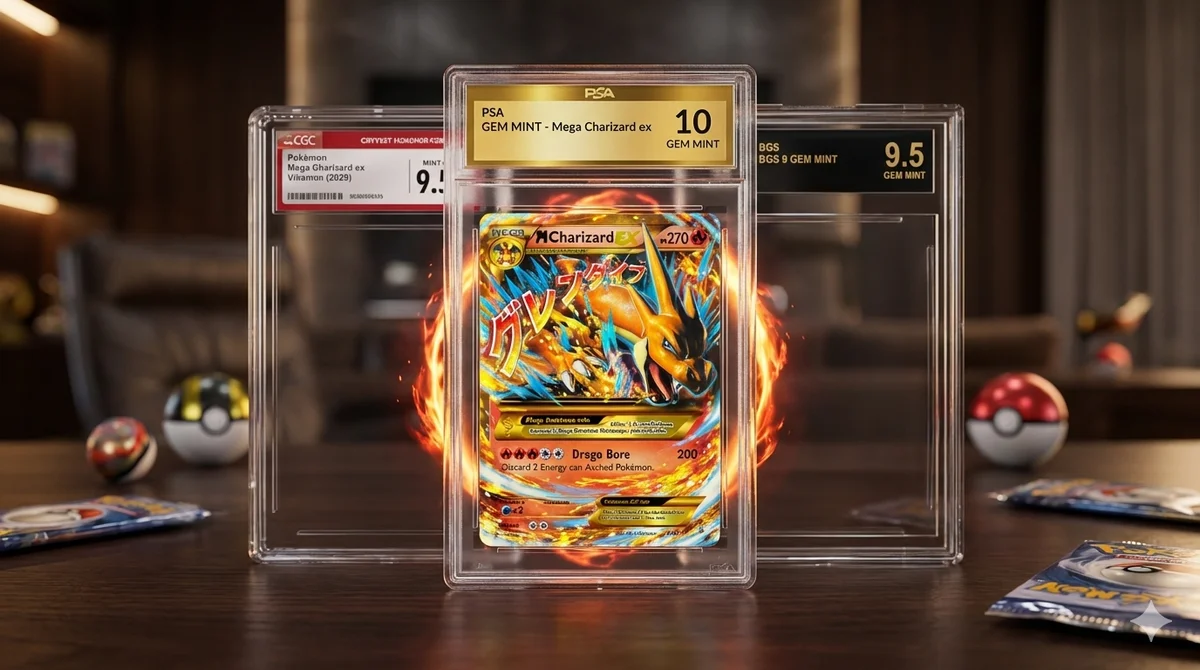
How to Grade Pokémon Cards: PSA vs BGS vs CGC — Complete Comparison 2026
📘 EXPERT GRADING GUIDE: Deciding to grade your Pokémon cards can multiply their value exponentially, but choosing the wrong grading company or submitting cards in poor condition can cost you time and money. This 2026 guide breaks down everything you need to know about PSA, BGS, and CGC.
Quick Answer: To grade a Pokémon card, you must carefully evaluate its condition (centering, corners, edges, surface), sleeve it in a penny sleeve and semi-rigid holder, and submit it to a grading company. PSA remains the undeniable king for overall market liquidity and ROI. BGS (Beckett) is best for flawless, high-end modern chase cards where you hope to hit a "Black Label" pristine 10. CGC offers the fastest turnaround times, the clearest crystal cases, and excellent value for error cards. Grading typically costs $15 to $40 per card depending on the service level and declared value.
If you have pulled a valuable Mega Charizard from a recent Ascended Heroes pack or found your childhood binder, your first question is likely: "Is it worth grading these?"
In this comprehensive guide, we compare the "Big Three" grading companies—Professional Sports Authenticator (PSA), Beckett Grading Services (BGS), and Certified Guaranty Company (CGC)—to help you navigate the 2026 grading landscape.
Key Takeaways
- 🏆 PSA is the standard: A PSA 10 is the most liquid, recognized grade in the Pokémon hobby.
- ⚫ BGS Black Label is the peak: A BGS 10 Black Label commands a massive premium over a PSA 10, but is incredibly difficult to achieve.
- ⚡ CGC represents speed & clarity: CGC has the most modern slab design, fastest standard turnaround times, and is the industry authority on misprints/errors.
- 💰 Grading costs vary: Expect to pay $15–$50 per card for standard tiers, with upcharges if a card is exceptionally valuable.
- 🛡️ Prep is everything: Cleaning surface dust (carefully!) and packaging with semi-rigid holders prevents shipping damage.
⚡ Quick Navigation
Is it worth grading Pokémon cards?
📌 TL;DR: Look at the "Raw" price of your card vs the "Gem Mint 10" and "Mint 9" price. If a Mint 9 sells for significantly more than the cost of the raw card plus grading fees, it's worth grading. Never grade base-tier cards or bulk.
Grading a card authenticates it, encapsulates it in a protective sonic-welded plastic case (the "slab"), and assigns it a condition grade from 1 (Poor) to 10 (Gem Mint/Pristine).
The goal of grading is simple: Value Multiplication and Preservation.
For example, looking at the most expensive Pokémon cards of all time, a raw First Edition Charizard might sell for $4,000–$6,000 if it looks okay, but a PSA 10 authenticated copy has sold for over $300,000.
The 4 Pillars of Card Condition
Graders evaluate your card using four main criteria:
- Centering: Are the borders perfectly even on all four sides, both front and back?
- Corners: Are they perfectly rounded without any whitening or fraying?
- Edges: Do the sides of the card show any 'silvering' or chipping?
- Surface: Are there microscopic scratches, print lines, indentations, or holographic foil bleeds?
PSA vs BGS vs CGC: The 2026 Comparison
Here is a macro-view comparison of the Big Three in 2026. Note that "Subgrades" refer to specific grades shown on the label for Centering, Edges, Corners, and Surface.
| Feature | PSA (Professional Sports Authenticator) | BGS (Beckett Grading Services) | CGC (Certified Guaranty Company) |
|---|---|---|---|
| Market Popularity | 🥇 #1 Market Leader | 🥈 #2 For High-end / Modern | 🥉 #3 Fastest growing |
| Resale Liquidity | Highest | High | Good (improving fast) |
| Slab Design | Minimalist, Red Label, Slim | Thick, Durable, Inner Sleeve, Gold/Silver/Black labels | Crystal Clear, Modern Black Label (new format) |
| Provide Subgrades? | ❌ No | ✅ Yes (Optional but recommended) | ❌ No (Discontinued for standard) |
| Best Used For... | Vintage, Standard chase cards, high liquidity selling | Flawless modern chase cards, Autographs | Errors/Misprints, fast flips, clean display |
PSA Grading Cost and Overview
PSA is the undeniable king of the Pokémon card grading market.
If you check any collection and price tracking tool, PSA 10 listings are the benchmark for a card's "ceiling" value.
PSA Grading Cost (2026 Estimated)
Note: Prices require a PSA Collectors Club Membership for bulk tiers.
- Value/Bulk Tier ($499 Max Declared Value): ~$15 – $19 per card (45–60 days)
- Regular Tier ($1,499 Max Declared Value): ~$75 per card (10–15 days)
- Express Tier ($2,499 Max Declared Value): ~$150 per card (5 days)
Pros of PSA
- Highest Liquidity: A PSA 10 is easier and faster to sell than any other slab.
- Lenient Centering: PSA allows a 60/40 centering tolerance on the front and still awards a PSA 10, making them slightly more forgiving than BGS.
- Set Registry: The PSA Set Registry gamifies collecting, driving immense demand for PSA slabs.
Cons of PSA
- No Subgrades: You simply get a "10". You don't know why it got a 10 or why your card got a 9.
- "Upcharging": If you submit a card at the $15 tier and it grades a 10, bringing its value to $2,000, PSA will hold your card and "upcharge" you to the $150 tier before returning it.
BGS Grading Cost and Overview
Beckett (BGS) is the prestige option for flawless modern cards.
BGS is famous for having four different label colors. A standard BGS 10 has a gold label (meaning one or two subgrades might be a 9.5). But the holy grail of collecting is the BGS Black Label pristine 10—meaning the card scored a perfect 10 in Centering, Surface, Edges, and Corners.
BGS Grading Cost (2026 Estimated)
- Base Tier (No Subgrades): ~$18 per card (30–60 days)
- Standard (With Subgrades): ~$22 per card (30–60 days)
- Express: ~$40 per card (10 days)
Pros of BGS
- The Black Label Premium: A BGS Black Label can sell for 3x to 10x the price of a PSA 10.
- Thick, Premium Slab: The BGS case feels like a vault. It features an inner protective sleeve that prevents movement.
- Subgrades: BGS clearly tells you exactly where your card lost points.
Cons of BGS
- Tougher Grading: A BGS 9.5 is roughly equivalent to a PSA 10. Getting a true BGS 10 is extremely rare.
- Inconsistent Resale: A BGS 9 usually sells for less than a PSA 9. If you miss the 9.5 or 10, you might lose money compared to PSA.
CGC Grading Cost and Overview
CGC has rapidly captured market share with ultra-clear slabs and aggressive pricing/turnarounds.
Originally famous for grading comic books, CGC aggressively entered the TCG market. In recent years, they revamped their label to a sleek black design and removed standard subgrades, aligning more closely with PSA's appearance.
CGC Grading Cost (2026 Estimated)
- Bulk Tier ($250 Max Declared Value): ~$12 – $14 per card (30–40 days)
- Economy ($1,000 Max Declared Value): ~$25 per card (15–20 days)
- Express ($10,000 Max Declared Value): ~$75 per card (3–5 days)
Pros of CGC
- Best Clarity: The CGC slab is widely considered the best looking for displaying artwork, with highly transparent plastic.
- Error Experts: If you pull an "Error" card (miscut, ink smear, crimped edge), CGC is the undisputed best company to grade and verify the error.
- Fastest Turnarounds: Historically, CGC has the best operational speed of the Big Three.
Cons of CGC
- Lower ROI: While improving, a CGC 10 still general sells for 10-20% less than a PSA 10 of the same card.
- Recent Label Changes: Older blue-label CGC slabs exist, meaning the secondary market has split aesthetics.
BGS 10 vs PSA 10: Which is Better?
This is the most common debate in the Pokémon community.
- A PSA 10 is an excellent, pack-fresh card. However, PSA allows up to 60/40 centering on the front. This means two PSA 10s of the same card can look slightly different.
- A BGS 10 (Gold Label) is inherently a 'stronger' grade than a PSA 10 because BGS is stricter on centering (requires 50/50).
- A BGS 10 Black Label is flawless perfection.
Conclusion: Selling a BGS 10 (especially a Black Label) will net you more money than a PSA 10. However, the risk of grading with BGS is much higher. If that card comes back a BGS 9.5, it sells for about the same as a PSA 10. If it comes back a BGS 9, it sells for less than a PSA 9. For 95% of collectors, PSA provides the safest and most consistent return on investment.
How to Prepare and Submit Cards for Grading
Sending your valuable cards in the mail can be terrifying. Follow these strict steps to ensure they arrive safely and get the best possible grade.
- Pre-Grade Your Cards: Use a magnifying glass and a bright desk lamp. Check the back borders for ANY whitening. Check the holo pattern for hairline scratches. If you see visible flaws, the card will likely score an 8 or worse.
- Clean the Surface: Use a clean microfiber cloth to gently buff away fingerprints or dust off the surface of the card. Do not press hard.
- The Sleeve Setup: Place the card into a brand new, clean Penny Sleeve. Pro tip: Snipping a tiny piece of the top corner off the penny sleeve before putting the card in makes it easier for the grader to pull the card out safely.
- Card Saver / Semi-Rigid: Slide the sleeved card into a "Semi-Rigid" holder (like Card Saver 1s). Do NOT submit cards in Top Loaders to PSA or CGC. Top loaders allow the card to slide around and get damaged during transit.
- Pack Carefully: Place your stack of semi-rigids between two pieces of stiff cardboard, rubber band them securely (but not too tight to bend them), and place them in a bubble mailer or box with plenty of void-fill.
Frequently Asked Questions
PSA vs BGS: Which is better for Pokémon cards?
For maximum resale liquidity, safety, and consistent ROI, PSA is better for Pokémon cards. For modern, absolutely flawless chase cards where you want to gamble for a massive premium "Black Label," BGS is the better choice.
Is it worth grading Pokémon cards?
Yes, but only if the card is valuable in its "Raw" state ($25+ usually) and is in near-mint to mint condition. Grading bulk cards, common cards, or cards with heavy edge-wear is a guaranteed way to lose money due to grading fees.
What is the Pokémon card grading near me?
You cannot usually grade cards "near you" unless you attend a massive TCG convention (like a Collect-A-Con) where PSA, BGS, or CGC have on-site grading booths. Otherwise, you must mail your cards to their headquarters (PSA is in California/New Jersey, BGS is in Texas, CGC is in Florida).
How much does PSA grading cost vs BGS grading cost?
PSA bulk grading costs around $15 per card (with a membership), while BGS baseline grading without subgrades is roughly $18. Costs scale dramatically based on the declared value of the card and how quickly you want it returned.
Can you grade fake Pokémon cards?
No. Valid grading companies authenticate the card first. If a card is counterfeit, they will reject it, return it to you in a plastic flip (ungraded), and in most cases, they will still charge you the grading fee.
Final Verdict: Who Should You Choose in 2026?
Grading is an integral part of high-end Pokémon collecting. It protects the legacy of the cards and creates a standardized market.
- Choose PSA if: You want the safest return on investment, highest liquidity, and have vintage or modern chase cards.
- Choose BGS if: You pulled a genuinely flawless card with perfect 50/50 centering and want to chase the Black Label premium.
- Choose CGC if: You want the fastest turnaround time, have error cards, or simply prefer the crystal-clear display for your personal collection.
PokéWallet API is now live — start tracking card prices for free:
- 💰 Real-time prices from TCGPlayer & CardMarket — free on every plan
- 🃏 50,000+ cards database — complete TCG coverage across all modern sets
- 📊 Historical price charts — track trends over weeks, months, and years
- 🔔 Price alerts — get notified when cards hit your target buy price
- 📈 Collection portfolio tracking — know your total collection value in real time
- 🔍 Set analytics — see which sets are performing best for collectors and investors
Stay Updated:
- 🚀 Start Free — No credit card required
- 📝 Read more Pokémon TCG guides and market analysis
- 💬 Join our Discord for collector community discussion and price alerts
- 📱 Follow @pokewallet.io for daily card reveals and market updates
Track real-time Pokémon card prices for free. No credit card required.