How to Spot Fake Pokémon Cards: 10 Authentication Tests You Can Do at Home
Learn how to spot fake Pokémon cards with 10 at-home authentication tests. Detect counterfeit cards using the light test, rip test, texture check, and more — no special equipment needed.
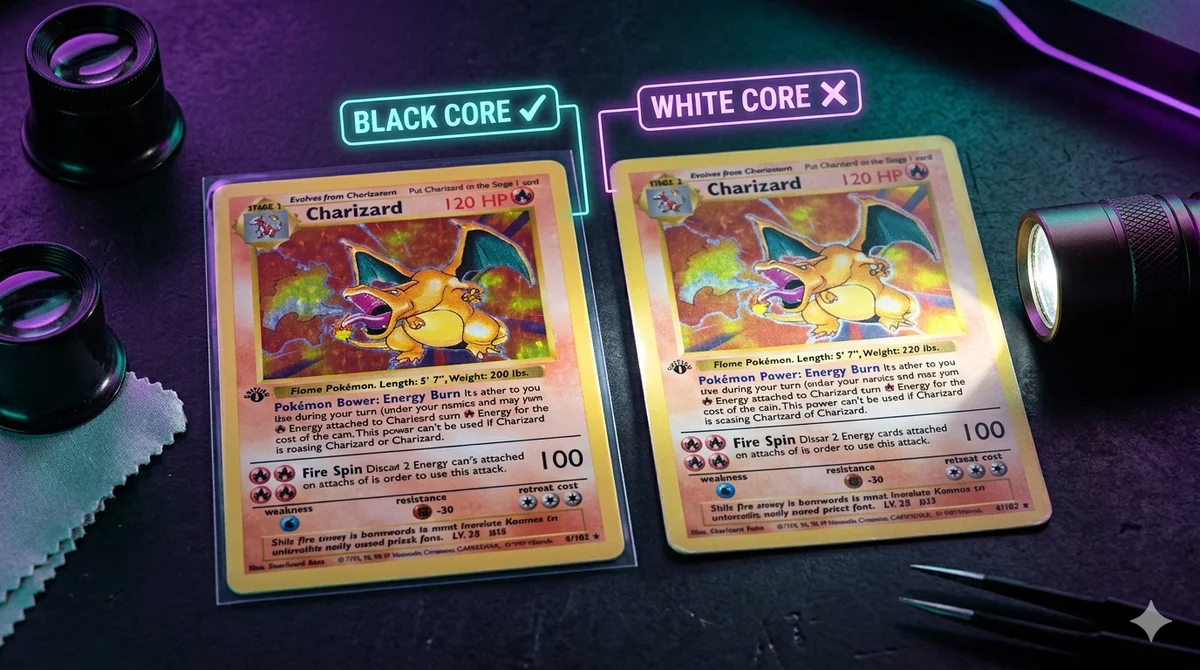
🛡️ AUTHENTICATION GUIDE: The Pokémon counterfeit market is more sophisticated than ever in 2026. With rare cards selling for hundreds to thousands of dollars, knowing exactly how to authenticate a card before buying or selling is a critical skill every collector must have.
Quick Answer: The fastest way to spot a fake Pokémon card is to perform the light test — hold the card up to a bright light source. Real cards have a distinct black inner layer visible between the front and back. Fakes lack this layer or show a grey/white core. Other instant red flags include blurry text, incorrect font weight, abnormal card thickness, and a glossy texture on the back. All 10 tests below can be performed at home with zero special equipment.
The counterfeit Pokémon card market generates tens of millions of dollars in fraudulent sales every year. Whether you're buying from a private seller, a marketplace listing, or even opening a suspicious booster pack, the ability to detect a fake card is now a core part of the hobby.
This guide gives you a systematic, hands-on framework — 10 clear tests you can perform at home — to confidently authenticate any Pokémon card.
Key Takeaways
- 🔦 The Light Test is your first check: Real cards show a black inner layer when held to light. Fakes do not.
- 📄 Font and text are the most cloned incorrectly: Counterfeiters rarely nail Pokémon's proprietary font — look for thicker or thinner lettering.
- 📏 Card thickness matters: Real cards measure ~0.32 mm (±0.02 mm). Fakes are often thinner or more rigid.
- 🎨 Holo pattern is extremely hard to replicate: Authentic holofoil has a distinct, consistent starburst or cosmos pattern. Fakes appear flat, blurry, or over-saturated.
- 🔢 The copyright line never lies: Real cards have precise, small-font copyright details. This is one of the hardest things for counterfeiters to replicate accurately.
⚡ Quick Navigation
Why the Counterfeit Problem is Getting Worse in 2026
Before we dive into the tests, it is important to understand why this matters more than ever.
The value of key Pokémon cards has exploded. A first-edition Charizard PSA 10 can exceed $300,000. Even modern ultra-rare cards from sets like Phantasmal Flames or Ascended Heroes regularly sell for $200–$1,500. This level of value makes counterfeiting highly profitable.
Counterfeit card quality has also improved dramatically. Basic fakes from a decade ago were immediately obvious — pixelated artwork, wrong colors, flimsy card stock. Modern "super fakes" from 2024–2026 can fool the untrained eye at first glance. They are printed on card stock that looks and feels almost identical to the real thing, use high-resolution scans of authentic cards, and even replicate holo patterns to a degree.
The tests below are ordered from fastest/easiest to perform to more detailed/technical. You should start with Tests 1–3 for a quick ruling, then use the remaining tests to confirm your findings.
Test 1: The Light Test
📌 TL;DR: Hold the card firmly against a bright light. Look for a distinct black inner layer running through the middle of the card's edge. This is the single most reliable authentication test.
This is the gold standard first test for any Pokémon card. All genuine Pokémon cards manufactured by The Pokémon Company International (TPCi) are printed on a specialized three-layer cardstock:
- Front layer — the printed face of the card
- Black inner core — an opaque black paper layer sandwiched in the middle
- Back layer — the blue-backed Poké Ball design
How to perform the test:
- Hold the card up to a natural window light, a strong desk lamp, or your phone's flashlight pointed directly at the card's edge.
- Look through the short edge (the top or bottom of the card).
- You should see a clearly visible dark/black strip running horizontally through the center of the card's thickness.
What fake cards show:
- A grey or white core — the counterfeit paper has no black layer, so light passes through more easily.
- A uniform, translucent glow through the entire card — this means it is a single-layer print on thin paper.
- A brownish or beige core — often seen in lower-quality fakes using standard cardstock.
This test alone can rule out the vast majority of counterfeits. If the card passes, proceed to the next tests.
Test 2: The Font and Text Check
📌 TL;DR: Use a magnifying glass or phone macro camera. Authentic cards use a proprietary, crisp font. Counterfeit fonts are almost always slightly too bold, too thin, or have inconsistent letter spacing.
The text on Pokémon cards is printed using licensed, proprietary fonts. The HP number, card name, attack names, damage numbers, and flavor text are all precisely sized and weighted.
What to look for:
- Card Name: Authentic names use a bold, slightly condensed sans-serif font. Fakes often have letter spacing that looks slightly too wide or text that appears blurry when magnified.
- HP number: The HP figure in the top right is large and bold. On fakes, it is often a touch thicker or thinner than normal.
- Attack damage numbers: Real cards have sharp, clean damage numbers. Look at the bottom-right of the attack box. Blurry or slightly pixelated numbers are a red flag.
- Copyright line: This is the hardest element for counterfeiters to replicate accurately. On real cards, the copyright text at the bottom is extremely small but perfectly crisp. On fakes, it is often blurry or slightly smudged.
- Set symbol and card number: The set symbol must match exactly. Compare it against a verified database or our Pokémon Card Rarity Guide.
Pro tip: Take a photo of the suspect card with your phone camera and zoom in to 4x or 8x. This is often enough to spot font inconsistencies that are invisible to the naked eye.
Test 3: The Rip Test
⚠️ WARNING: This test destroys the card. Only perform this on a card you are certain is fake, or use a bulk/common card you do not intend to keep.
The rip test is the definitive "ground truth" authentication method. It physically reveals the internal layer structure of the card.
How to perform the test:
- Take the card and bend it gently until it tears across the middle.
- Examine the torn edge closely.
- A real Pokémon card will show a clear black paper layer sandwiched between two white/cream paper layers.
- A fake card will show a plain white or grey internal layer with no black strip.
Most counterfeit cards, even high-quality ones, cannot replicate the proprietary black inner layer because it requires specialized printing equipment. This makes the rip test essentially definitive.
When to use this test: Reserve for cards you are dealing with in bulk or already strongly suspect. For potentially valuable authentic cards, use the non-destructive tests (1, 2, 4–10) instead.
Test 4: Holo Pattern Inspection
📌 TL;DR: Tilt the card under a single light source. Real holo cards show a repeating geometric pattern (starburst, cosmos, or set-specific motif). Fakes look flat, rainbow-smeared, or uniformly shiny.
This test applies specifically to Holo Rare, Ultra Rare, and Secret Rare cards which feature a foil finish.
The holofoil on genuine Pokémon cards is produced by a separate stamping and lamination process. Different eras and sets use different holo patterns:
| Era | Common Holo Pattern |
|---|---|
| Base Set – Gym Heroes (Vintage) | Classic "shooting stars" or diagonal lines |
| EX Series – BW Era | Sunburst/starburst repeating pattern |
| XY – Sun & Moon | Set-specific patterns (cosmos, ripple, etc.) |
| Sword & Shield – Scarlet & Violet / Modern | Intricate geometric tessellation or etched patterns |
How to perform the test:
- Hold the card under a single desk lamp or overhead light (avoid diffuse ambient light).
- Tilt the card slowly back and forth.
- On a real card, the holo pattern will move, shift, and sparkle with a consistent repeating geometric design. It has "depth" to it.
- On a fake card, the holo layer tends to look like a flat holographic sticker — it shimmers uniformly rather than showing a distinct pattern. It often appears rainbow-smeared when tilted.
Special case — Illustration Rares and Special Illustration Rares (SIRs): These modern card types have a textured, etched foil on the entire card. If the foil on these cards appears flat or plasticky rather than having a subtle raised texture, the card is almost certainly fake. Track legitimate SIR prices using PokéWallet's real-time price tracker to understand when a deal is suspiciously cheap.
Test 5: Card Thickness and Feel
📌 TL;DR: Real Pokémon cards are approximately 0.32 mm thick. They have a slight, consistent flex and feel neither too rigid nor too flimsy. Fake cards often fail on at least one of these dimensions.
Thickness: A standard Pokémon card measures approximately 0.32 mm thick (±0.02 mm). You can measure this with a standard digital caliper (available for under $10). If the card is below 0.28 mm or above 0.36 mm, it is very likely fake.
Rigidity: Hold the card with two hands and apply very slight flex pressure across the middle (portrait orientation). A real card:
- Has a consistent resistance and springs back gently.
- Does not crease immediately.
- Does not feel unusually stiff or cardboard-like.
Fake cards often feel either:
- Too stiff — like a rigid plastic or thick photography paper, with very little natural flex.
- Too flimsy — almost like printer paper, bending and creasing at the slightest touch.
Texture: Run your thumb across the back of the card. Real cards have a subtle, consistent texture — not completely smooth, but not rough either. The surface has a slight "tooth" to it from the printing process. Fake card backs are often overly smooth (from a single lamination layer) or have an artificial rough texture that feels uneven.
Test 6: The Back Design Check
📌 TL;DR: The back of every Pokémon card features a specific shade of blue and a precise Poké Ball design. Color accuracy and border width are the two most commonly failed elements on fakes.
Every standard Pokémon TCG card (outside of promotional or special backs) uses the same back design: a blue-framed Poké Ball illustration. This design is highly consistent across all official sets.
What to check:
- Blue tone: The blue of the card back is a specific royal blue. Fakes often print this as navy (too dark), cobalt (too bright), or turquoise (too cool). Compare directly next to a card you know is real.
- Inner yellow border: There is a thin yellow border around the card back design. On real cards, this border is crisp and even. On fakes, it is often blurry, uneven in width, or incorrect in shade.
- Poké Ball detail: The Poké Ball itself should be perfectly defined with clean black outlines and a clear circular button in the center. Counterfeit backs often have slightly blurry or fuzzy outlines on the Poké Ball.
- Outer white border: The outer white edge of the card should be evenly white, not cream or yellowish. A yellowish tint can indicate old, poor-quality paper stock.
A note on "miscut" backs: Do not confuse a legitimate Wizards of the Coast (WotC) miscut card with a fake. Genuine miscuts have proper internal layers and sharp print quality — they are simply off-center from the factory cutting process.
Test 7: The Color Saturation Check
📌 TL;DR: Hold a suspect card next to a confirmed authentic card of a similar type. Counterfeit cards are often over-saturated (too vivid) or under-saturated (washed out) compared to real prints.
Color calibration is extremely difficult to replicate perfectly. Even high-quality counterfeit operations using near-professional printing equipment struggle to match TPCi's precise color profiles.
What to look for:
- Over-saturation: The most common fake flaw. Colors look unnaturally vivid — almost neon. The artwork pops in a way that seems "off" when compared directly to a real card.
- Under-saturation: Less common but seen in cheaper fakes. Colors look faded or washed out, as if the card has been in sunlight for years, even when brand new.
- Incorrect skin tones on Trainer cards: Trainer cards feature human characters. If the skin tones look oddly pink, orange, or grey, the color calibration is wrong.
- Yellow energy symbol: On Pokémon cards, the yellow used in energy symbols and card name text boxes has a very specific warm golden tone. On fakes, it often prints as a flat bright yellow.
This test is most effective when you have a direct comparison. If you don't have a known-authentic reference card of the same art, use a high-resolution scan from a trusted database.
Test 8: The Magnified Print Check
📌 TL;DR: Under magnification (10x+), real cards show a precise CMYK dot pattern. Fake cards show irregular dots, blurring, or visible pixel patterns from digital inkjet printing.
This is the most technical test, but it is accessible with a simple jeweler's loupe (a 10x magnifying glass costs under $5 on any marketplace) or your phone's camera with a macro attachment.
How to perform the test:
- Set up a bright, consistent single light source (no flash — it washes out the dots).
- Hold the loupe or macro lens directly above the card's artwork area, not the text.
- Focus carefully on the printed art.
What real cards show: A precise CMYK (Cyan, Magenta, Yellow, Black) halftone dot pattern. The dots are tiny, perfectly round, and arranged in a consistent rosette pattern. This is the hallmark of professional offset printing on a commercial press.
What fake cards show:
- Inkjet patterns: Irregular, elongated dots or visible "dithering" — a chaotic spray pattern instead of a clean rosette.
- Laser printer artifacts: Toner clumping, slightly melted dot edges, or static-charge "banding" across the image.
- Resolution pixelation: If the counterfeit used a low-resolution card scan, you may see blocky pixel edges under magnification.
This test is definitive for identifying high-quality "super fakes" that pass the visual and texture tests but were still produced on consumer-grade printing equipment.
Test 9: Energy Symbol and Icon Consistency
📌 TL;DR: Pokémon energy symbols (Fire, Water, Grass, etc.) have fixed, precise designs. Counterfeiters frequently distort their proportions or shade them incorrectly.
Every Pokémon type has a standardized energy symbol used in attack costs, Weakness, Resistance, and Retreat Cost. These symbols are vector-based assets used consistently across all cards. Because they are simple icons, counterfeiters sometimes distort them accidentally when scaling or when using imprecise reference images.
What to check:
- Flame symbol (Fire): Should have exactly three distinct flame "tongues" — two short outer ones and one tall central one. Fakes sometimes show two evenly-sized flames or an uneven base.
- Water symbol: Should look like a clean water droplet. Fakes often make this too round or too elongated.
- Psychic symbol: A starburst with a specific number of points. Extra or missing points are an immediate red flag.
- Retreat Cost icons: The icons on the bottom of the card near the Retreat Cost are small and easy to blur. If they look smeary or out of proportion, be suspicious.
Also check the Weakness and Resistance formatting. Real cards use a consistent formula (e.g., ×2 or -30). The font size and spacing of these values is fixed. Fakes frequently have incorrect spacing or use the wrong multiplier format.
Test 10: Cross-Reference with a Verified Database
📌 TL;DR: If any previous test raised doubts, compare the card side-by-side against a verified high-resolution reference image. Look for differences in artwork crop, card number, and set symbol placement.
This is your final confirmation test. If a card has passed Tests 1–9 but you still have doubts, cross-reference it against a trusted source.
How to perform the test:
- Note the card's full name, set symbol, and card number (bottom of the card, e.g., 025/198).
- Search for this exact card on a verified TCG database or marketplace (TCGPlayer, CardMarket, Bulbapedia).
- Find a high-resolution scan of the verified authentic card.
- Compare the following elements specifically:
- Artwork crop: Is the artwork framed identically? Fake cards sometimes crop the artwork slightly differently.
- Card number placement: The set number (e.g., 025/198) should be in a specific position relative to the card border.
- Illustrator credit: Real cards list the illustrator's name in small text near the card number. Cross-check this against the verified database.
- Edition marks: First Edition or "Shadowless" stamps must be exactly the right size, font, and position for vintage cards. These are heavily faked.
Bonus: Use the PokéWallet API to cross-check a card's current market price. If someone is selling a card worth $500 for $50 and "it looks the same," it is almost certainly counterfeit.
Quick Reference: Fake vs Real Comparison Table
| Test | Real Pokémon Card | Fake Pokémon Card |
|---|---|---|
| Light Test | Black inner core visible | Grey, white, or no inner layer |
| Font | Crisp, precise proprietary font | Slightly too bold/thin, irregular spacing |
| Rip Test | Black layer between two white layers | Uniform grey/white layers only |
| Holo Pattern | Geometric, depth, moves as you tilt | Flat, rainbow smear, uniform shine |
| Thickness | ~0.32 mm, consistent flex | Too stiff or too flimsy |
| Card Back | Precise royal blue, clean Poké Ball | Off-color blue, blurry outlines |
| Color | Accurate, true-to-art saturation | Over- or under-saturated |
| Print Pattern | CMYK rosette dots under magnification | Inkjet/laser dots, irregular or pixelated |
| Energy Icons | Precise, correctly proportioned | Distorted, wrong number of elements |
| Database Match | Identical artwork crop, artist, number | Small discrepancies in layout/crop |
What to Do If You Receive a Fake Card
If you have confirmed a card is counterfeit, here are your next steps:
- Do not resell it. Knowingly selling a counterfeit card is illegal in most jurisdictions and violates the Terms of Service of every marketplace.
- Report it to the platform. TCGPlayer, eBay, and CardMarket all have dedicated processes for reporting counterfeit sales. You can typically get a full refund.
- Report it to The Pokémon Company. TPCi has an active program to combat counterfeiting. You can submit a report via their official website.
- Alert the community. If you identified a specific scam listing or seller, share the information on Reddit (/r/pokemontrades) or the relevant Discord communities. Community awareness helps protect other collectors.
- Consider grading for expensive future purchases. Submitting high-value cards to PSA, BGS, or CGC is the definitive method of authentication. Once a card is in a graded slab, its authenticity is certified by a third party.
Frequently Asked Questions
How can you tell if a Pokémon card is fake without destroying it?
The most reliable non-destructive tests are the light test (checking for the black inner layer), font inspection under magnification, holo pattern check (tilting under a single light), and card thickness measurement with a caliper. Combining these four tests can confidently confirm or rule out a fake without physically damaging the card.
What is the light test for Pokémon cards?
The light test involves holding a Pokémon card against a bright light source (a lamp or phone flashlight) and looking through the card's short edge. A genuine card will show a visible black inner core running through the center of the card's thickness. Counterfeit cards lack this layer and appear uniformly translucent or show a grey/white core.
Are fake Pokémon cards illegal to buy or sell?
Selling counterfeit Pokémon cards is illegal under intellectual property and fraud laws in most countries. Purchasing fakes is typically not illegal for personal use, but selling or distributing them constitutes counterfeiting. Knowingly reselling a fake card as genuine is fraud.
Can grading companies detect fake Pokémon cards?
Yes. PSA, BGS, and CGC all authenticate cards before grading them. If a submitted card is identified as counterfeit, the company will reject it, return it in a plastic flip ungraded, and in most cases still charge the submission fee. Graders are trained to spot fakes that would fool most collectors.
Do fake Pokémon cards have the correct set number?
Most fake cards include a set number copied from the authentic version. However, the number's font, size, and positioning often differ slightly from the genuine card. Cross-reference the set number against a verified database to check for discrepancies.
What are "super fakes" in Pokémon cards?
"Super fakes" are high-quality counterfeits produced on near-professional printing equipment using high-resolution scans of authentic cards. They pass basic visual inspection and can even replicate the card's weight and texture. They typically fail the light test (no black inner core) and the magnified print check (showing inkjet or inferior dot patterns instead of CMYK rosettes).
How do I protect myself when buying Pokémon cards online?
Only buy from reputable sellers with strong feedback histories on verified marketplaces (TCGPlayer, CardMarket). For high-value cards ($100+), request additional photos of the card back, card edge, and holo pattern under tilted light before purchasing. Consider only buying PSA/BGS/CGC graded copies of extremely valuable cards — once it's in a slab, its authenticity is certified.
Final Verdict: Trust Your Instincts, Then Verify
Spotting fake Pokémon cards in 2026 requires a layered approach. No single test is 100% foolproof against the most sophisticated super fakes — but running through Tests 1–4 (Light, Font, Rip, Holo) will catch the overwhelming majority of counterfeits.
The best protection remains buying from reputable sellers, using authenticated graded copies for high-value purchases, and tracking fair market prices so you are immediately suspicious when a deal seems too good to be true.
If you want to track real-time prices for the cards you collect, our platform makes it easy to see exactly what a card is legitimately worth before any transaction.
PokéWallet API is now live — start tracking card prices for free:
- 💰 Real-time prices from TCGPlayer & CardMarket — free on every plan
- 🃏 50,000+ cards database — complete TCG coverage across all modern sets
- 📊 Historical price charts — track trends over weeks, months, and years
- 🔔 Price alerts — get notified when cards hit your target buy price
- 📈 Collection portfolio tracking — know your total collection value in real time
- 🔍 Set analytics — see which sets are performing best for collectors and investors
Stay Updated:
- 🚀 Start Free — No credit card required
- 📝 Read more Pokémon TCG guides and market analysis
- 💬 Join our Discord for collector community discussion and price alerts
- 📱 Follow @pokewallet.io for daily card reveals and market updates
Track real-time Pokémon card prices for free. No credit card required.