One Piece TCG Investment Guide 2026: Best Sets & Cards to Buy Now
The definitive One Piece TCG investment guide for 2026. Which sets and cards are worth buying right now? Expert analysis of OP01–OP03, the best Alternate Art and Manga Rare investments, sealed vs singles strategy, and what the market data actually says.
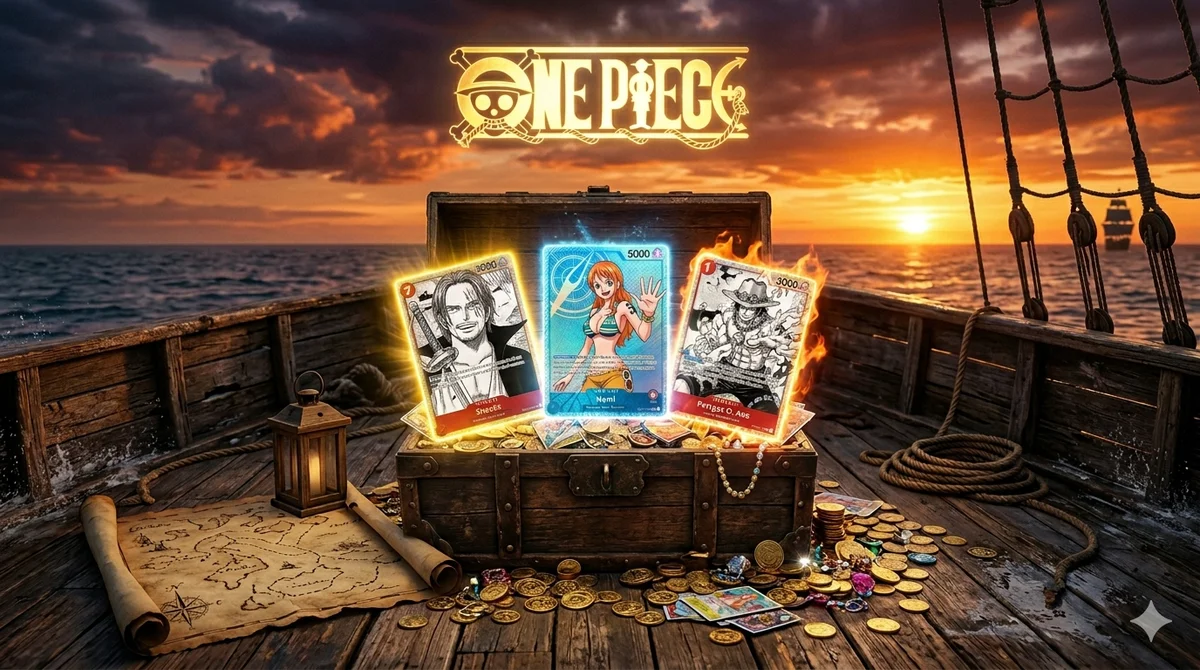
One Piece TCG Investment Guide 2026: Best Sets & Cards to Buy Now
💰 INVESTMENT GUIDE: This guide provides data-driven analysis of the One Piece TCG secondary market as of mid-2026. It covers which sets and individual cards represent the best risk-adjusted investment opportunities, the sealed product vs singles debate, and the structural factors driving long-term value. This is not financial advice — all investing carries risk, and TCG markets are inherently volatile. Verify all prices independently before making acquisition decisions.
Quick Answer (TL;DR): Is one piece tcg a good investment in 2026? Yes — but only if you understand what you are buying and why. The best one piece sets to buy for long-term appreciation remain OP01 (Romance Dawn) and OP02 (Paramount War) for sealed product, while the best one piece cards worth money for singles investment are the Manga Rares (Shanks, Ace) and the top character-driven Alternate Art Leaders (Nami OP03, Katakuri OP03, Zoro OP01). The One Piece TCG market in 2026 has transitioned from its speculative early phase to a more mature, fundamentals-driven collector economy — which means smarter entry points but also more demanding due diligence.
In 2022, the One Piece TCG launched into a market that was hungry, well-capitalized, and deeply familiar with what happened when people ignored the early Pokémon card market. The result was extraordinary: Romance Dawn OP01 boxes appreciated 400%+ in their first three years. Manga Rare Shanks went from a $45 booster pack lottery ticket to a $2,500 certified collectible. Alternate Art Leaders that retailed at pull-rate expected value now command prices that would make early Pokémon investors nod knowingly.
But the landscape in mid-2026 is materially different from 2022. The explosive early appreciation phase has largely concluded for foundation-era sets. The market has matured. New sets are being printed in higher volumes. And collectors who enter now face a fundamentally different risk-reward profile than day-one participants.
This one piece tcg investment guide answers the critical question for 2026: what is actually worth buying now, what are the structural risks, and how should you build a One Piece TCG investment position that makes sense?
⚡ Quick Navigation
Why One Piece TCG Has Investment Fundamentals
Before examining specific cards and sets, it is worth establishing why the One Piece TCG has genuine, structural investment merit — not just speculative hype.
The IP Foundation Is Bulletproof
One Piece is the best-selling manga series in history, with over 530 million copies sold across 107+ volumes. The anime has run continuously since 1999 and is currently in its most commercially successful arc globally. Eiichiro Oda's health permitting, the story is progressing toward its conclusion — a narrative event that market analysts across every collectible category agree will generate a massive, sustained demand spike for One Piece memorabilia of all kinds, including trading cards.
This is not the same as collecting a trading card game tied to a video game franchise or a flash-in-the-pan anime. One Piece has proven 25-year longevity. The collector base that enters the market in the next 5–10 years will look back at 2026 foundation-era set prices the same way 2000s collectors look at 1990s Pokémon prices.
The Market Has Matured But Not Peaked
The explosive 400–500% appreciation window for OP01 and OP02 is largely closed for new buyers entering at 2026 prices. This is actually a positive signal, not a negative one: it means the market has transitioned from speculation to fundamentals. Cards are now priced based on genuine collector demand, character popularity, and supply scarcity — not purely on FOMO or speculative momentum. Fundamentals-driven markets are more predictable, more durable, and more rewarding for patient, informed investors.
The Secondary Market Infrastructure Is Strong
CardMarket, TCGPlayer, eBay, and dedicated One Piece TCG marketplaces now provide deep liquidity for OP singles. PSA and BGS actively grade One Piece cards. Major auction houses have accepted high-value OP submissions. This infrastructure — largely absent in the game's first year — dramatically reduces liquidity risk for large-position holders.
Best Sets to Invest In 2026
Set Investment Comparison Table
| Set | Current Sealed Box Price | 3-Year Appreciation | Top Chase Card Value | Investment Rating |
|---|---|---|---|---|
| OP01 Romance Dawn | $180 – $250 | +400%+ | Manga Shanks: $1,200–$2,500 | ⭐⭐⭐⭐⭐ Hold / Small add |
| OP02 Paramount War | $120 – $170 | +200%+ | Manga Ace: $1,000–$1,600 | ⭐⭐⭐⭐⭐ Hold / Buy |
| OP03 Pillars of Strength | $90 – $140 | +150%+ | Nami AA: $280–$550 | ⭐⭐⭐⭐ Buy |
| OP04 Kingdoms of Intrigue | $70 – $110 | +80%+ | Sanji AA / Robin AA: $200–$500 | ⭐⭐⭐⭐ Buy |
| OP05 Awakening of the New Era | $55 – $85 | +30%+ | Zoro AA: $150–$350 | ⭐⭐⭐ Selective Buy |
| OP06 Wings of the Captain | $45 – $70 | +10%+ | Luffy AA: $100–$250 | ⭐⭐⭐ Watch |
| OP07 500 Years in the Future | $45 – $65 | ~0% | — | ⭐⭐ Too early |
| OP08 Two Legends | $45 – $60 | ~0% | — | ⭐⭐ Too early |
Tier 1: Foundation Era (OP01, OP02) — The Blue-Chip Holds
Romance Dawn OP01 and Paramount War OP02 are the established blue chips of the One Piece TCG. The sealed product appreciation window has largely closed, but holding existing positions remains strongly advisable. New buyers entering at current prices face lower absolute upside than day-one participants, but the floor is solid — the "genesis set" premium for OP01 is permanent and irreducible, while OP02's Marineford emotional anchor creates demand that is structurally independent of meta shifts.
Verdict: Hold all existing positions. Small new sealed positions in OP02 ($120–$170 per box) are still justified with a 3+ year horizon. For OP01, focus capital on singles (Manga Shanks, Zoro AA Leader) rather than additional sealed boxes at current prices.
For detailed set analysis: Romance Dawn OP01 Complete Guide and Paramount War OP02 Complete Guide.
Tier 2: Character-Demand Sets (OP03, OP04) — The Buy Window
Pillars of Strength OP03 and Kingdoms of Intrigue OP04 represent the clearest current buying opportunities in the One Piece TCG investment landscape. Both sets:
- Are priced well below the foundation era, creating better risk-adjusted entry points
- Contain character-driven chase cards (Nami, Katakuri, Sanji, Robin) whose demand is structurally independent of competitive meta shifts
- Were printed before the higher-volume era sets, meaning sealed supply is genuinely constrained
- Are positioned in the "collector retroactive demand" sweet spot — new entrants building systematic collections will acquire OP03 and OP04 as their next sets after OP01/OP02
Verdict for OP03: Buy sealed ($90–$140 per box) and prioritize Nami AA Leader and Katakuri AA as singles. For detailed set analysis see our Pillars of Strength OP03 Complete Guide.
Verdict for OP04: OP04 (Kingdoms of Intrigue) contains some of the most expensive individual Alternate Art cards in the entire game — Sanji and Robin AA cards commanding $200–$500+. Strong buy on targeted singles; sealed product at current prices is also reasonable for patient holders.
Best Individual Cards to Buy Now
The singles market offers the most surgical, capital-efficient way to build an One Piece TCG investment position in 2026. Here are the top individual card investment opportunities, ranked by risk-adjusted return potential.
Top 10 One Piece TCG Cards Worth Buying in 2026
- Manga Rare Shanks (OP01-120 Manga) — $1,200 – $2,500 The apex of One Piece TCG collecting. Irreplaceable supply, unparalleled historical significance, and genuine cultural cachet as the card that defined the game's collectible ceiling. For patient long-term holders, the upside remains substantial. See where it ranks in our most expensive One Piece TCG cards of all time.
- Manga Rare Ace (OP02-013 Manga) — $1,000 – $1,600 The emotional counterpart to Manga Shanks. Ace's narrative significance in One Piece lore — and the raw emotional response his character provokes in the fanbase — creates a demand driver that is permanently embedded in the card's value. PSA 10 specimens approaching $2,000 represent legitimate long-term appreciation potential.
- Roronoa Zoro (Alternate Art Leader — OP01) — $180 – $350 The "Zoro Tax" is permanent. Any card featuring Roronoa Zoro carries a baseline premium driven by one of the most fervent single-character fanbases in all of anime. The OP01 AA Leader is the purest expression of this premium — his first, and most iconic, Alternate Art in the game.
- Nami (Alternate Art Leader — OP03) — $280 – $550 The most aggressively appreciated character-driven Alternate Art Leader in the OP03 era. Character demand from non-competitive collectors creates a price floor that competitive meta shifts cannot erode.
- Charlotte Katakuri (Alternate Art — OP03) — $150 – $320 Katakuri's reputation as the finest antagonist in the post-timeskip era drives collector demand that will only increase as new anime viewers reach his arc. Strong hold; selective buying at current prices is justified.
- Portgas D. Ace (Secret Rare SEC — OP02) — $50 – $80 The accessible entry point for Ace collectors who cannot access the Manga Rare. Strong character demand and genuine scarcity (only 2 SECs per set) make this a reliable, lower-capital investment within the OP02 ecosystem.
- Monkey D. Luffy (Alternate Art Leader — OP01) — $120 – $250 The protagonist's first AA Leader. Character demand from the game's brand ambassador ensures permanent baseline value. Slightly less liquid than Zoro's AA but with comparable long-term fundamentals.
- Edward Newgate / Whitebeard (Alternate Art Leader — OP02) — $200 – $400 Whitebeard's AA Leader has demonstrated the strongest per-card appreciation among OP02 Alternate Art Leaders over the past 18 months, driven by the character's growing reputation in the global fanbase as the game's most tragically powerful figure.
- Vinsmoke Sanji (Alternate Art Leader — OP04) — $200 – $500 OP04's Sanji AA is one of the most aggressively demanded singles in the mid-era sets. The combination of Sanji's massive global fanbase, the stunning artwork of his most iconic form, and OP04's deeper character roster creates sustained, multi-demographic demand.
- Trafalgar Law (Alternate Art Leader — OP01) — $80 – $160 Law's competitive meta relevance and sustained narrative importance give his OP01 AA Leader unusual dual-driver demand: both competitive players and collectors want it. This creates more stable pricing than pure collector-driven cards.
Sealed Product vs Singles: The 2026 Verdict
This is the most important strategic question for One Piece TCG investors in 2026, and the answer has shifted since the game's early days.
The Case for Sealed Product
Sealed booster boxes offer three advantages that singles cannot replicate:
- Supply permanence: Every box opened reduces the global sealed supply permanently. The sealed floor rises steadily and irreversibly as years pass.
- Lottery premium: A sealed box contains the possibility of a Manga Rare or exceptional Alternate Art. This potential upside is reflected in sealed pricing and provides a speculative layer above pure singles value.
- Storage and authentication simplicity: Sealed product is easier to store, authenticate, and liquidate than a portfolio of raw single cards.
Best sealed plays in 2026: OP01 (hold only), OP02 ($120–$170 per box), OP03 ($90–$140 per box).
The Case for Singles
For capital-efficient, targeted investing, singles offer advantages sealed cannot match:
- Precision: You buy exactly the cards with the strongest investment thesis — Manga Rares, top AA Leaders — without paying for the Commons, Uncommons, and filler Rares that comprise 80%+ of a booster box's contents.
- Grading leverage: PSA 10 premiums on top chase cards can be 1.5x–2x over raw pricing. Grading a targeted single delivers an investment return that no sealed box can approximate on a per-dollar basis.
- Faster liquidity: A PSA 10 Manga Shanks sells in days. A sealed case of OP01 requires the right buyer.
Best singles plays in 2026: Manga Rares (Shanks, Ace), Nami AA Leader OP03, Zoro AA Leader OP01, Whitebeard AA Leader OP02.
The 2026 Verdict
For investors with $500–$2,000 to deploy: singles provide better risk-adjusted returns. Target PSA-gradeable Manga Rares or top AA Leaders in demonstrably excellent condition.
For investors with $2,000–$10,000+: a hybrid approach is optimal — 60% in targeted singles, 40% in sealed product from OP02 and OP03 that can be held for 3–5 years.
Risk Factors: What Can Go Wrong
Honest investment analysis requires acknowledging the risks, not just the upside.
1. Bandai Reprint Risk
This is the most frequently cited risk and deserves a measured response. Bandai has shown willingness to reprint high-demand sets in Japan (OP01 received additional print runs). However, Manga Rares have never been reprinted, and English edition reprints have been significantly smaller in volume than the original printings. The structural scarcity of foundation-era sealed product is real, but not absolute.
Mitigation: Prioritize Manga Rares and PSA-graded singles over raw sealed product if reprint risk concerns you.
2. IP Decline Risk
While the probability of One Piece experiencing a sudden, catastrophic IP decline is extremely low given the franchise's structural strength, it is not zero. Any TCG investment carries IP risk.
Mitigation: Diversify across multiple TCGs. For a direct comparison of the One Piece and Pokémon collector markets, see One Piece TCG vs Pokémon TCG: Which to Collect in 2026.
3. Market Liquidity Risk
At the very high end — PSA 10 Manga Shanks, large-format sealed cases — finding a buyer at your target price can take time. The market is liquid for mid-tier cards but thinner at the extremes.
Mitigation: Plan for 30–90 day selling horizons at peak value. Never invest capital you may need to liquidate quickly.
4. Condition and Authentication Risk
Raw (ungraded) high-value cards carry counterfeiting and condition misrepresentation risk on secondary markets. This is particularly acute for Manga Rares.
Mitigation: Buy from established sellers with verified feedback, or buy PSA/BGS graded specimens only for cards above $300.
Frequently Asked Questions
Is One Piece TCG a good investment in 2026?
Yes, with appropriate expectations. The early explosive appreciation phase is over for foundation sets, but the fundamentals — IP strength, supply scarcity, collector demand driven by character attachment — remain intact. The one piece tcg investment thesis in 2026 is a patient, fundamentals-driven hold, not a speculative flip. Treat it like a collectible, not a meme stock.
What are the best One Piece TCG cards to invest in right now?
The clearest opportunities are the Manga Rares (Shanks from OP01 at $1,200–$2,500, Ace from OP02 at $1,000–$1,600) for maximum capital commitment, and the top Alternate Art Leaders (Nami OP03 at $280–$550, Zoro OP01 at $180–$350, Whitebeard OP02 at $200–$400) for mid-range positions. All of these cards have character-driven demand that outlasts any competitive meta shift.
Which One Piece TCG sets are best for sealed product investment?
OP02 (Paramount War) at $120–$170 per box offers the best current entry point for sealed investment — strong character roster, Manga Rare Ace, and significant appreciation runway. OP03 (Pillars of Strength) at $90–$140 is the more accessible alternative. OP01 is worth holding but represents a high-cost new entry position at $180–$250 per box.
Should I grade my One Piece TCG cards before selling?
For any card above $200 in raw value that is in visually excellent condition (well-centered, no edge wear, clean surface), grading through PSA or BGS is worth the investment. The PSA 10 premium on top chase cards is typically 1.5x–2x over raw pricing. For cards below $100, grading costs generally exceed the marginal value increase.
How does One Piece TCG compare to Pokémon TCG as an investment?
The structural comparison favors One Piece for new investors entering in 2026 primarily because the floor is lower and the relative upside is higher at current prices. Pokémon Base Set 1st Edition is already at astronomical prices with limited new buyer upside; OP01 at $180–$250 per box has meaningful appreciation potential remaining. For a full head-to-head analysis, see our One Piece TCG vs Pokémon TCG comparison guide.
What's the minimum capital needed to start a One Piece TCG investment portfolio?
A meaningful foundation position can be built for $300–$500:
- 1 PSA-gradeable Alternate Art Leader (Zoro OP01 or Nami OP03 in excellent condition): $150–$300
- 1 OP02 sealed booster box: $120–$170 This gives you exposure to both the singles market and sealed product appreciation with manageable capital at risk.
Final Assessment: The Grand Line Investor's Playbook
The One Piece TCG in 2026 rewards investors who understand the difference between speculation and fundamentals. The speculative phase — buying anything with "OP01" on the label and waiting — is over. The fundamentals phase — buying the right characters, in the right condition, from the right sets, at the right price — has replaced it.
The framework is straightforward:
- Manga Rares are the highest-conviction, lowest-liquidity assets. Buy graded if possible.
- Top Alternate Art Leaders (Nami, Zoro, Whitebeard, Sanji) are the optimal balance of conviction, liquidity, and accessible price points.
- Sealed product from OP02 and OP03 offers the most accessible new entry points for sealed product exposure.
- Foundation era (OP01, OP02) positions should be held; new capital is better deployed at OP02/OP03 prices.
The Grand Line is long. Patience, precision, and a genuine understanding of what drives One Piece card value — character devotion, narrative weight, supply permanence — is the only reliable compass.
Build and track your One Piece TCG investment portfolio:
- 📊 Real-Time Market Data: Track the live value of every card in your OP portfolio with TCGPlayer and CardMarket prices through the One Piece Card Game API — now live and free to use.
- 🚀 Start Tracking for Free Today — Know exactly what your collection is worth at any moment.
- 💬 Discuss investment strategies, share market data, and track Manga Rare price movements with fellow collectors in our Discord Community.
The best investors on the Grand Line don't chase treasure blindly. They navigate by data. Track it with PokéWallet.